
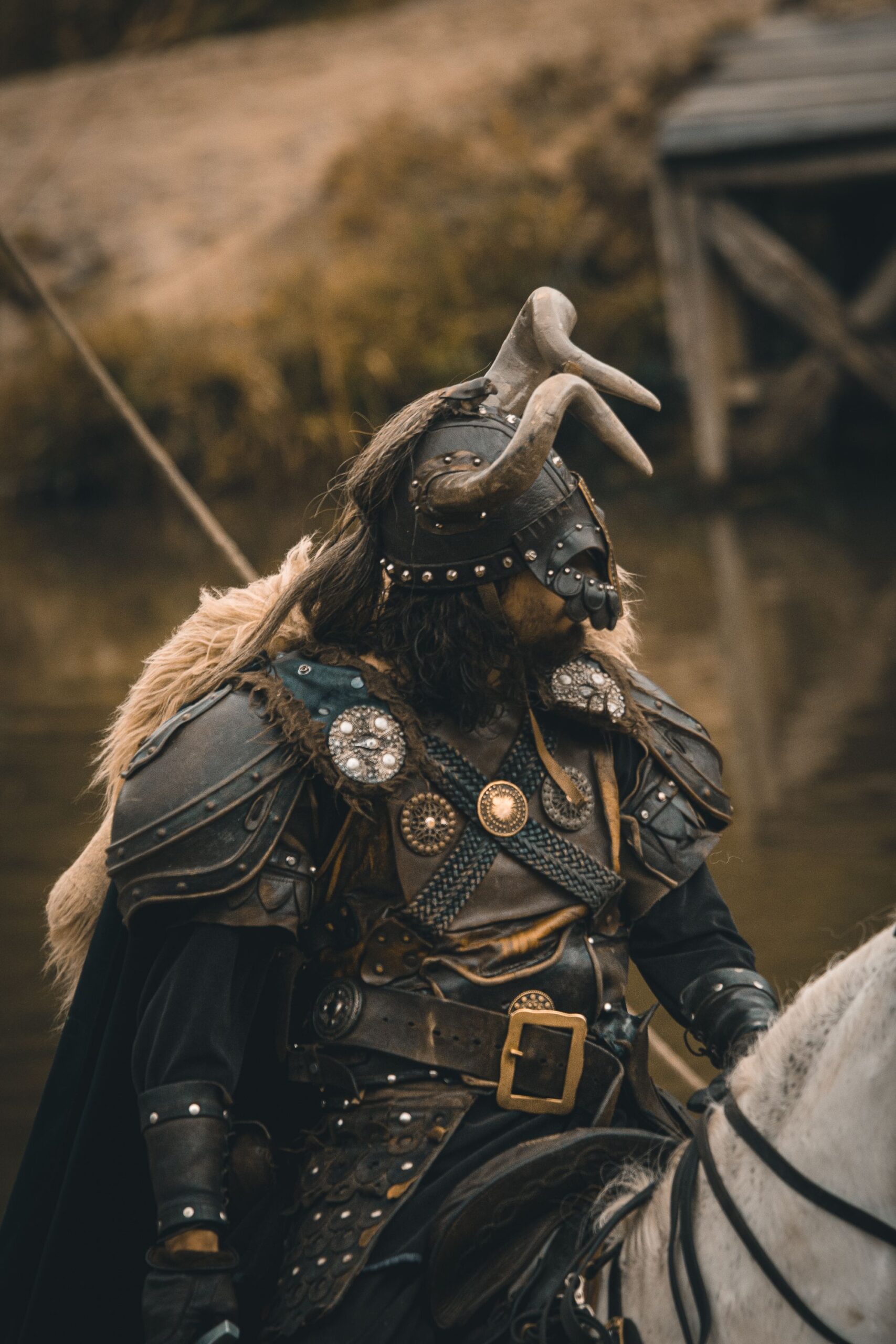
Who Is Heimdall? The Guardian of the Bifrost
Heimdall stands as one of the most enigmatic and essential figures in Norse mythology. Known as the “White God,” he is the ever-vigilant sentinel who guards the Bifrost Bridge—the rainbow pathway connecting Asgard, the realm of the gods, to Midgard, the world of humans. His role is not merely passive observation; Heimdall is the first line of defense against the giants and other forces that threaten the cosmic order. With superhuman senses that allow him to hear grass grow, see for hundreds of miles, and require less sleep than a bird, Heimdall embodies the archetype of the perfect watchman. His name, often interpreted as “he who illuminates the world,” underscores his function as a bringer of clarity and warning.
Physical Attributes and Divine Senses
Heimdall’s physical description is as striking as his abilities. He is often portrayed with gold teeth, a gleaming white complexion, and a horn called Gjallarhorn, whose name translates to “yelling horn” or “loud-sounding horn.” According to the Prose Edda by Snorri Sturluson, Heimdall is “the whitest of the gods,” a phrase that may signify purity, solar connections, or a distinct lineage among the Aesir. His senses are his most defining trait: he requires so little sleep that he is effectively perpetually awake. He can see for a hundred leagues, both day and night, and his hearing is so acute that he can discern the sound of wool growing on sheep or the silent growth of grass. This hyper-awareness makes him an indispensable guardian, as no threat can approach Asgard unnoticed.
Origins and Birth: The Nine Mothers
Few deities have a genealogy as unusual as Heimdall’s. He is described as the son of nine mothers, all of whom are sisters. These mothers are often identified as the waves or sea giants, linking Heimdall to the primordial forces of the ocean. The Völuspá, a key poem in the Poetic Edda, mentions that Heimdall was “born of nine mothers, the daughters of the sea giant Aegir.” This aquatic origin is significant: it places him between two worlds—the chaotic, elemental forces of the giants and the ordered civilization of the gods. Some scholars interpret this birth story as an allegory for the meeting of land and sea, or for the nine realms themselves. Regardless, it grants Heimdall a unique status among the Aesir, making him both a bridge and a boundary.
Gjallarhorn: The Sound of Doom and Deliverance
Gjallarhorn is arguably Heimdall’s most famous possession—a horn whose blast will herald the beginning of Ragnarök, the end of the Norse world. According to the Prose Edda, the horn is kept near the base of Yggdrasil, the World Tree, and can be heard throughout all nine realms when blown. During Ragnarök, Heimdall will raise Gjallarhorn to his lips, and its sound will awaken the gods to the final battle. The horn is not merely a weapon or tool; it is a symbol of cosmic alarm. Interestingly, some sources suggest that Heimdall also uses Gjallarhorn to signal shifts in the seasons or to announce important events, though its primary function remains apocalyptic. The horn’s mystique is amplified by its connection with Mímir’s well, where Odin sacrificed an eye for wisdom—Heimdall is said to have buried Gjallarhorn beneath the roots of Yggdrasil, entwining his fate with the lifeblood of the cosmos.
The Bifrost Bridge: Asgard’s Rainbow Gateway
The Bifrost Bridge is the shimmering, multi-colored pathway that connects Asgard to Midgard, and Heimdall is its sole guardian. In Norse cosmology, the bridge is depicted as a burning rainbow that prevents unworthy beings from crossing—only those pure of intent or possessing divine permission may traverse it. Heimdall’s duty involves constant surveillance of the bridge, ensuring that frost giants, mountain giants, or other malevolent entities do not infiltrate the gods’ realm. The bridge is also a site of vulnerability: during Ragnarök, the forces of chaos will storm across Bifrost, and the bridge will shatter under their weight. Heimdall’s vigilance, therefore, is not only a routine watch but a preparation for an inevitable, catastrophic breach.
Heimdall’s Role in the Æsir-Vanir War
Heimdall’s involvement in the historical conflicts of the gods reveals his strategic importance. During the war between the Aesir and Vanir, two tribes of gods, Heimdall is said to have stood as a neutral but observant presence. Some sagas hint that his wisdom prevented the conflict from escalating into total annihilation. After the war’s end, the exchange of hostages included Heimdall being sent to the Vanir as a pledge of trust. This period among the Vanir likely tempered his warrior instincts with a deeper understanding of magic, fertility, and fate. His ability to navigate between warring factions underscores his role as a mediator and observer—a figure who watches not only for external threats but also for internal discord.
The God of Boundaries and Liminality
Heimdall is fundamentally a liminal deity, governing thresholds, transitions, and boundaries. His position at the edge of Asgard, his birth from sea giants, and his relationship with both gods and humans all place him at the crossroads of existence. In this capacity, he is associated with order, protection, and the maintenance of cosmic structure. Unlike Odin, who seeks wisdom through sacrifice and wandering, or Thor, who acts through brute force, Heimdall’s power lies in static vigilance. He is the gatekeeper who decides who enters and who is turned away—a role that carries immense responsibility. Some modern interpretations, including those in Marvel comics, have downplayed this liminal aspect, but in traditional sources, Heimdall is as much a philosopher as a warrior.
Heimdall and Human Society: The Ríg Narrative
Heimdall also holds a unique position in human society according to the poem Rígthula (The Song of Ríg). In this narrative, Heimdall travels through Midgard under the name Ríg, visiting three households: one poor, one middle-class, and one wealthy. He impregnates the women of each home, and the resulting sons become the ancestors of the three main social classes: thralls (serfs), karls (freemen), and jarls (nobles). This story endows Heimdall with the role of a cultural hero and social architect. It also deepens his connection to humanity, making him not just a distant guardian but a direct contributor to the formation of human hierarchy and civilization. Through this act, Heimdall binds himself to the fate of mortals, establishing a lineage that will exist until Ragnarök.
Prophecy and Ragnarök: The Final Duel with Loki
Heimdall’s most famous narrative moment occurs during Ragnarök, the prophesied end of the world. When the giants surge forward and the forces of chaos gather, Heimdall will blow Gjallarhorn to alert the gods. In the ensuing chaos, he will engage in a duel with Loki, the trickster god who embodies disorder and deception. According to the Völuspá, Heimdall and Loki will slay each other in a mutual, fatal strike. This confrontation is thematically profound: Heimdall, the embodiment of order, vigilance, and light, perishes at the hands of Loki, the embodiment of chaos, shadow, and shapeshifting. Their mutual destruction represents the collapse of all cosmic balances—every dualism that sustained the Norse universe dissolves into ash. Heimdall’s death is not a failure but a completion: his purpose was to guard until the very end, and he does so without retreat.
Symbolism and Modern Interpretations
In contemporary culture, Heimdall has been popularized largely through Marvel’s cinematic universe, where he is depicted as a dark-skinned warrior portrayed by Idris Elba. This version emphasizes his role as the gatekeeper of Asgard and the wielder of dark magic, but it diverges significantly from the mythological figure. In neo-pagan and Ásatrú traditions, Heimdall is invoked for protection, boundary-setting, and spiritual clarity. His golden horns and white aspect have also led to associations with solar deities and initiatory rites. Psychologically, Heimdall can be seen as the archetype of the “watcher”—the part of the psyche that remains alert to danger, subtle shifts, and the need for boundaries. His story reminds us that vigilance is not paranoid but necessary, and that the collapse of order often begins with a failure to observe.
Archaeological and Textual Evidence
The historical man known as Heimdall is preserved in fragmentary but crucial sources. The Poetic Edda, compiled in the 13th century from earlier oral traditions, contains several poems referencing him, most notably Völuspá, Grímnismál, and Rígthula. Snorri Sturluson’s Prose Edda provides a systematic account of his attributes, myths, and role in Ragnarök. Archaeological evidence, such as runestones and carvings from Viking Age Scandinavia, occasionally depicts a figure with a horn, but explicit identification with Heimdall remains speculative. One famous artifact, the Överhogdal tapestry from Sweden, shows a warrior blowing a horn amid scenes of Ragnarök, lending visual support to the textual tradition. Despite the sparse record, Heimdall’s consistency across sources suggests a widely recognized and deeply valued figure in Norse belief.
Rituals and Worship of Heimdall
Unlike Odin, Thor, or Freyr, Heimdall does not appear to have had widespread cultic worship or dedicated temples. He is not mentioned in place names (theonyms) across Scandinavia, nor are there records of sacrifices or seasonal festivals in his honor. This absence is curious but interpretable: Heimdall may have been venerated in a more personal, apotropaic manner—homeowners might call upon him to protect thresholds, or seafarers might invoke his watchful gaze over the horizon. His association with boundaries and entryways aligns with folk practices such as placing symbols of protection above doors. The lack of formal worship may also reflect his role as a solitary figure; his power is not communal but liminal. Those seeking to honor Heimdall today often do so through meditation on boundaries, acts of vigilance, and the use of horns or bells as ritual objects.
Comparisons with Other Mythological Figures
Heimdall shares traits with watchmen and boundary deities across world mythologies. In Greek mythology, he resembles Argus Panoptes, the hundred-eyed giant who served Hera as an ever-watching guardian. In Hindu tradition, the god Indra possesses a guardian of the cosmic bridge and a celestial horn. The Hindu figure of Hanuman, with his vigilance and devotion, offers parallel themes. Even the biblical cherubim stationed at the gates of Eden (Genesis 3:24) echo Heimdall’s role as a guardian preventing unlawful entry. In Celtic mythology, the figure of Mannanan mac Lir, a sea god and gatekeeper of the Otherworld, shares maritime origins and boundary-keeping duties. These cross-cultural similarities suggest that the archetype of the all-seeing watchman is a universal human need—guardianship against chaos, evil, and the unknown.
The Fate of Heimdall After Ragnarök
In the cyclical Norse cosmology, the world rebirths from the waters of chaos after Ragnarök. The Völuspá describes a new, fertile land where surviving gods reunite. Heimdall does not appear in these post-Ragnarök visions; his death alongside Loki is final. His horn, Gjallarhorn, likely becomes a relic of the old world, its sound silent in the new age. This permanence of death underscores the Norse belief in fate—even the gods are not immortal in the sense of eternal survival. Heimdall’s legacy, however, transforms into a mythic prototype of fidelity and sacrifice. He does what he is meant to do, without negotiation or escape, leaving a narrative footprint of courage that surpasses the bounds of time.
Practical Lessons from Heimdall for Modern Life
Beyond mythology, Heimdall offers psychological and practical wisdom. His story encourages mindfulness—the cultivation of acute awareness in daily life. In an age of distraction, the ability to “see” and “hear” what is subtle (grass growing, wool thickening) translates to noticing shifts in relationships, workplaces, or inner moods before they become crises. Heimdall’s resolve to sleep minimally is not a literal prescription, but a metaphor for staying present and alert. His boundary-keeping, embodied in the Bifrost Bridge, reminds us to protect personal energy, set limits, and know who to allow into our inner circles. For leaders, Heimdall exemplifies the need for vigilance without paranoia—an open-eyed calm that prepares for threats without being consumed by fear.
Heimdall in Popular Culture
Marvel’s interpretation of Heimdall, seen in Thor (2011) and subsequent films, has dramatically shaped public perception. Played by Idris Elba, this version wields a sword rather than a horn, possesses dark magic, and communicates through telepathic visions. While artistically compelling, this adaptation strips Heimdall of key attributes: his golden teeth, his white horses (Gulltoppr), and his nine mothers. Yet it retains his core identity as the loyal, but sometimes weary, sentinel. Video games like God of War (2018) and Assassin’s Creed Valhalla also feature Heimdall, often as an antagonist or complex ally. These modern portrayals keep Heimdall alive in the collective imagination, ensuring that the White God remains a figure of fascination for generations to come.